IUCN World Commission on Protected Areas (WCPA) Sustainable Finance Specialist Group
About the Sustainable Finance Specialist Group
Protected and conserved areas (PCAs) around the world continue to face serious financial and management challenges. It is now widely recognised that these extend far beyond a simple lack of funding. There is an equal need to make efforts to improve the diversity, stability and security of PCAs’ financial portfolios, ensure that funds are received in an appropriate form, at the right time and place, by the appropriate groups, and are managed and spent effectively according to the greatest management needs.
Just as PCAs are now recognised to encompass a diverse array of management regimes, governance arrangements and stewardship responsibilities, so there is a need to rethink how conservation finance is conceptualised and delivered. This requires moving beyond the traditional preoccupation with fundraising. The primary concern becomes to ensure that all of the groups that are responsible for and incur costs from managing PCAs and conserving nature are equipped to access sufficient finance, in a manner and a form that is suited to their unique needs and circumstances, and are able to use it to support their highest conservation priorities .
To these ends, the Sustainable Finance Specialist Group (SFSG) seeks to encourage, enable and empower PCA stakeholders to sustainably finance conservation, by sharing practical and policy-relevant knowledge, building awareness, capacity and learning, strengthening WCPA engagement and influence, and promoting effective, equitable and enduring finance solutions.
Our Priorities and Work Areas (2026-2029)
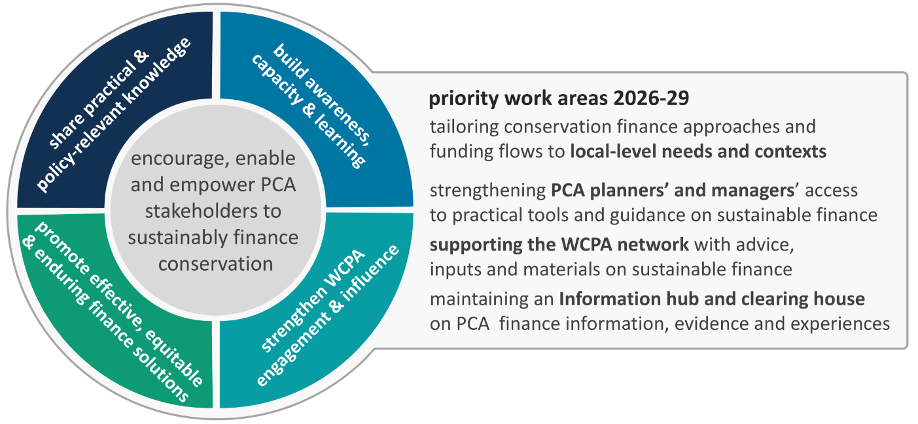
We plan to focus on four particularly important PCA finance topics and issues over the next quadrennium:
Tailoring conservation finance approaches and funding flows to local-level needs and contexts (for example, by engaging in efforts to tailor finance and funding mechanisms to the needs of community-conserved areas, especially those involving IP&LCs and ITTs);
Strengthening PCA planners’ and managers’ access to practical tools and guidance on sustainable finance (for example by extending the reach, usability and application of the 2025 “Practice Guidance for Protected and Conserved Area Finance” by developing planning tools and training modules for PCA practitioners);
Supporting the WCPA network with advice, inputs and materials on sustainable finance (for example by providing new platforms for collaboration, exchange and networking between SFSG members, and conducting joint activities with other WPCA Thematic, Working and Specialist Groups and Task Forces); and
Maintaining an Information hub and clearing house on PCA finance information, evidence and experiences (for example, to ensure that sustainable finance topics and events are embedded and showcased at the 2027 World Protected and Conserved Areas Congress, and facilitate SFSG members’ engagement).
New release 2025: IUCN WCPA Practice guidance for protected and conserved area finance

The Conservation Finance Alliance, IUCN World Commission on Protected Areas (WCPA), and its Sustainable Finance Specialist Group together with a wide range of global conservation finance experts have released the IUCN WCPA Practice Guidance for Protected and Conserved Area Finance as part of the IUCN WCPA Good Practice Guidelines Series. This essential new publication makes the case for PCA finance and provides actionable guidance on finance strategies exploring public, private, Indigenous, and site-based opportunities and needs. The guidance includes 16 Factsheets providing a deeper dive into a range of finance mechanisms. The guidance presents describes the role and use of finance and economics to achieve PCA outcomes and presents guidance on how to conduct strategic and practical financial planning in support of these outcomes.
Global Report on Protected Area Finance Capacity Needs
The report is based on a global survey of protected area practitioners in 2019 meant to inform the work of the Conservation Finance Alliance Working Group on Protected Area Finance to develop targeted protected area finance capacity development and training programs.
Group Leadership
Co-Chair: Dr. David Meyers
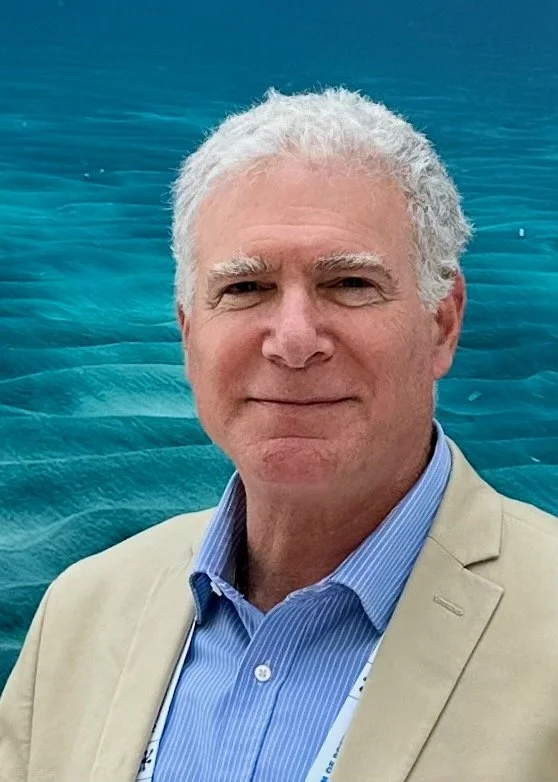
David Meyers is the Executive Director of the Conservation Finance Alliance. He is an environmental finance expert and entrepreneur with more than 25 years of experience in sustainability, business strategy and management, environmental economics, international conservation and development, environmental impact assessment, training, education and research in ecology and evolution. From 2012 until 2018, David was a Sr. Technical Advisor for the Biodiversity Finance Initiative (BIOFIN/UNDP). David has launched and managed various companies including a financial services company providing online marketplaces for impact investing and environmental assets, a triple-bottom-line bamboo-flooring manufacturer in Madagascar, and a technology incubator. At the CFA David has led the creation of the CFA Incubator and the Investment Plan for the Global Fund for Coral Reefs. David has spent well over a decade in Madagascar and has worked in 47 countries. In Madagascar, he helped the country plan and execute a doubling of the area under conservation, including establishing the Makira Natural Park 370,000 hectare protected area using REDD+ financing. He holds a Doctorate in Biological Anthropology and Anatomy from Duke University and an MBA from the Yale School of Management.
Co-Chair: Ms. Lucy Emerton
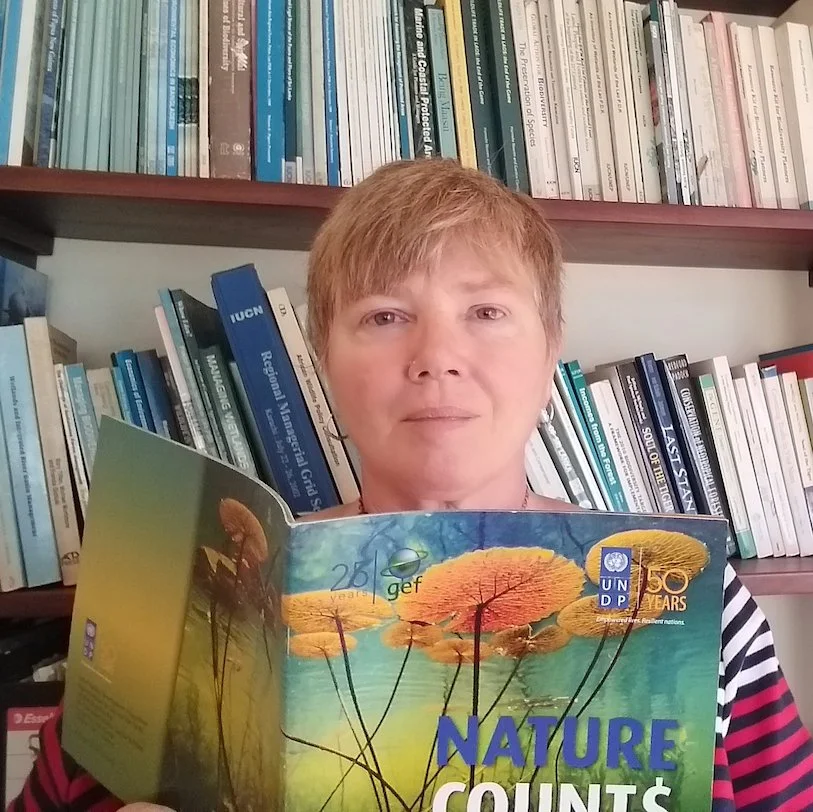
Lucy Emerton has degrees in social anthropology and development economics. She has been working as an environmental economist and conservation finance adviser for the last 35 years across more than 80 countries in Africa, Asia, the Caribbean, Europe, Latin America and the Middle East. Lucy’s work focuses particularly on the development of innovative conservation finance and incentive mechanisms, as well as economic and investment planning and decision-support tools such as biodiversity and ecosystem valuation and the development of conservation business cases and bankable projects. She has published extensively on these topics, and has developed and delivered a wide range of methodologies, guidelines and training modules for both economic and conservation decision-makers, practitioners and researchers. From 1990 to 1998, Lucy worked for the UK Government’s Department for International Development as an agricultural and natural resource economist in Kenya, led the development of African Wildlife Foundation’s conservation economics programme in Eastern and Southern Africa, and coordinated UNDP-GEF project activities on institutional strengthening of economic aspects of biodiversity conservation in East Africa. Between 1998 and 2008, she established and ran the environmental economics programmes of IUCN (the International Union for the Conservation of Nature) in Africa and Asia as well as providing technical oversight and backstopping to IUCN's economics activities in Latin America, Europe and at the global level. Since 2008 Lucy has been working as an independent technical advisor, policy strategist, trainer and researcher for GIZ, KfW, WCS, the World Bank, WWF, UNDP, UNEP, FAO and the International Centre for Tropical Agriculture (CIAT), as well as a variety of other bilateral, multilateral, non-governmental, United Nations and private sector organisations worldwide.
IUCN WCPA Sustainable Finance Specialist Group Page
Interested in Joining the Sustainable Finance Specialist Group?
Upcoming Events
Contact
Featured Articles